Princeton alumni awarded three of four 2026 Fields Medals in math
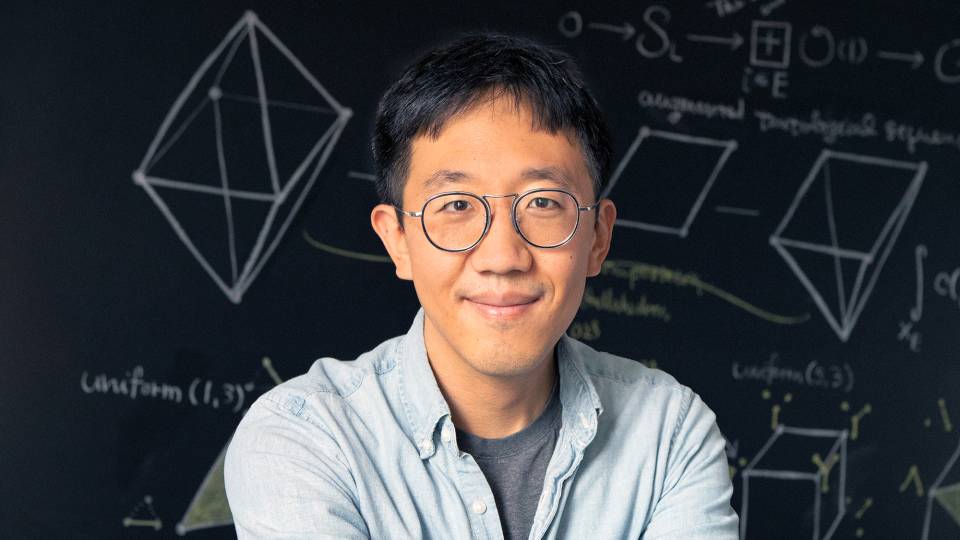
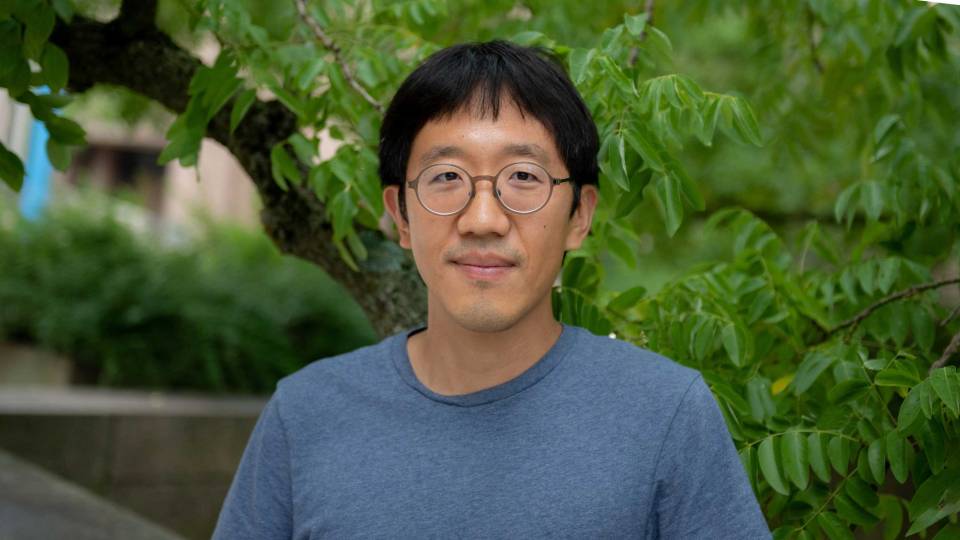
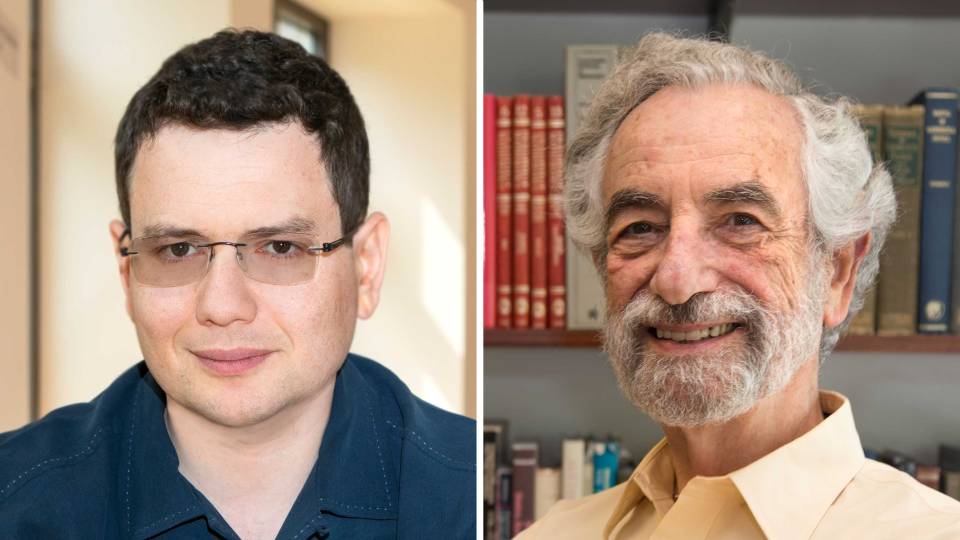
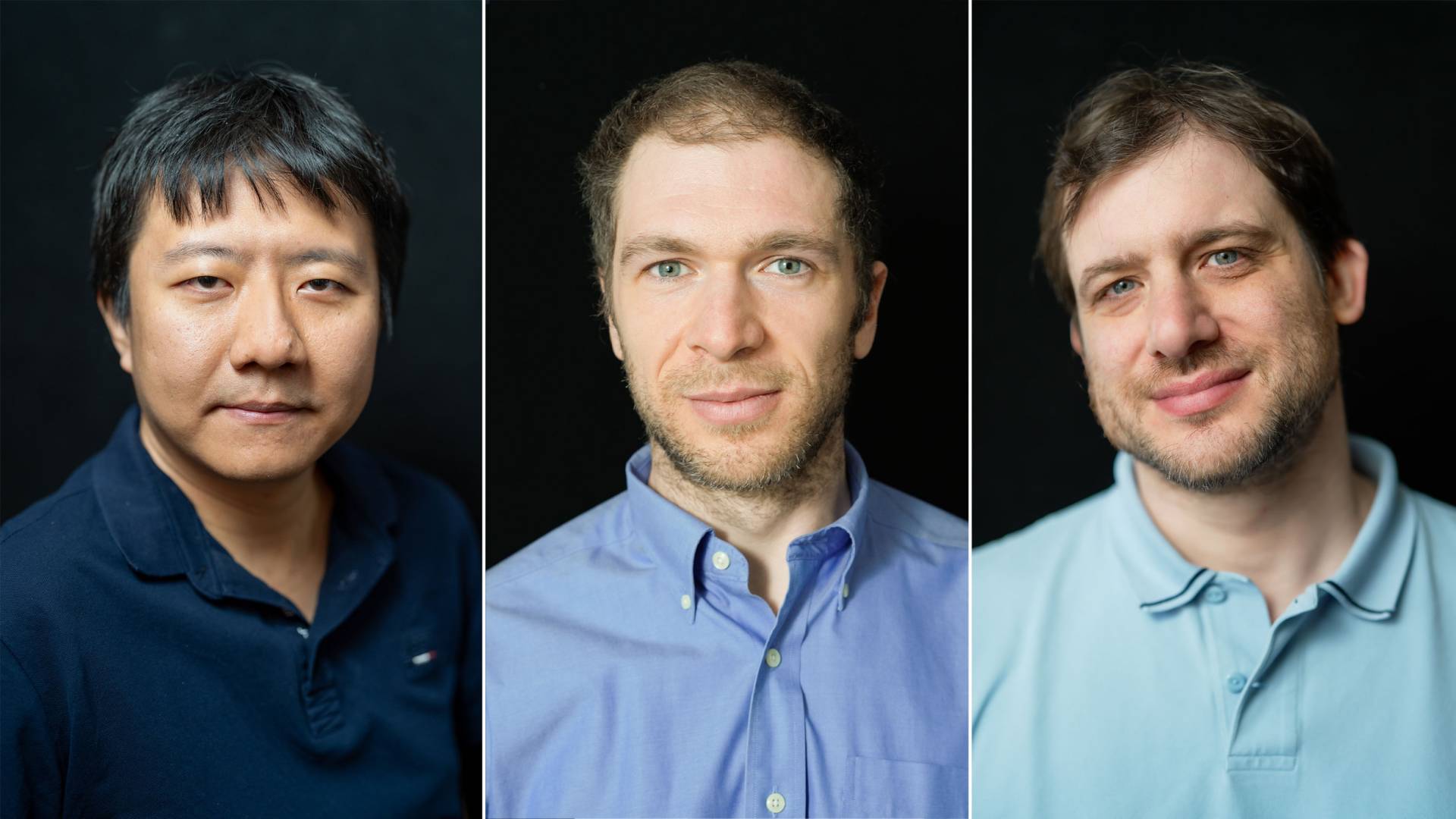
Yu Deng, John Pardon and Jacob Tsimerman
Three of the four Fields Medalists announced today by the International Mathematical Union are Princeton alumni: Yu Deng *15, John Pardon '11, who is a former mathematics faculty member, and Jacob Tsimerman *11.
The medal, awarded every four years to researchers under 40 years old, is one of the most prestigious awards in mathematics. It recognizes both “outstanding mathematical achievement for existing work" and "the promise of future achievement,” the IMU said in its 2026 Fields Medal announcement.
Christopher Skinner, Princeton professor of mathematics and chair of the department, extended warm congratulations to all of the 2026 Fields Medalists. “The awarding of the Fields Medal every four years is an opportunity to celebrate some great mathematics,” he said.
“But it is especially thrilling for the department to have the remarkable works of three of its alums awarded medals this year,” Skinner said. “Yu Deng *15, Jacob Tsimerman *11 and John Pardon '11 are exceptional talents, and we are delighted to see them getting this well-deserved recognition and to bask a little in the glow of their accomplishments.”
Yu Deng
Deng, who received his Ph.D. in mathematics from Princeton in 2015, was recognized “for his work in partial differential equations, including the rigorous derivation of the Boltzmann equation from hard-sphere dynamics for rarefied gases, the derivation of wave kinetic equations from nonlinear dispersive systems, and probabilistic approaches to nonlinear Schrodinger dynamics,” according to his Fields Medal citation.
At Princeton, he was a 2015 winner of the Porter Ogden Jacobus Fellowship, Princeton University’s top honor for graduate students.
Professor of Mathematics Alexandru Ionescu, his adviser, said at the time: “Yu Deng is not only a brilliant student, he is already an accomplished researcher, whose work has already had significant international impact.” Following the IMU announcement, he added, “It is a great pleasure to see him awarded the Fields Medal for his spectacular work in partial differential equations."
“He has solved major problems in the field, particularly at the interface of partial differential equations and probability, where his immense technical strength has consistently pushed the boundaries of our knowledge,” Ionescu said. "I sincerely congratulate him on this milestone and celebrate his ongoing impact on the discipline.”
Deng earned his B.S. in mathematics in 2011 from the Massachusetts Institute of Technology after transferring from Peking University in Beijing. He is a recipient of a 2026 Clay Research Award and a 2021 Sloan Research Fellowship.
Deng was an instructor at the Courant Institute of Mathematical Sciences from 2015 to 2018 and a professor at the University of Southern California from 2018 to 2024. He is now a professor of mathematics at the University of Chicago.
John Pardon
Pardon, an undergraduate alumnus originally from Chapel Hill, N.C., was valedictorian of Princeton’s Class of 2011. He was recognized with a 2026 Fields Medal for “his achievements in symplectic geometry including new approaches to virtual fundamental cycles, Fukaya categories of certain manifolds and counting holomorphic curves, and for his contributions to other areas of geometry and topology, including group actions on 3-manifolds and knot theory,” according to his medal citation.
As a Princeton senior, Pardon solved Gromov’s problem in the field of knot theory, which had eluded mathematicians for more than two decades.
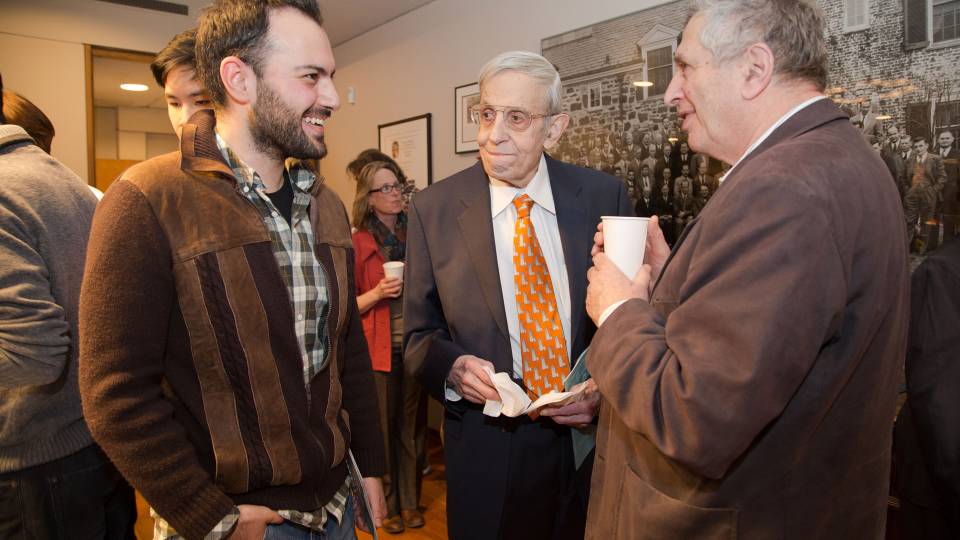
Zoltán Szabó, Princeton's Henry Burchard Fine Professor of Mathematics, first met Pardon shortly after he solved the problem — “an amazing feat,” Szabó said. “His senior thesis, ‘The link concordance invariant from Lee homology,’ was also an impressive work.”
The two would soon work as colleagues when Pardon returned to Princeton in 2016 — “now as a professor,” Szabó said. "I remember sitting in his graduate course and learning from him some of his latest discoveries on Fukaya categories and symplectic geometry.”
In his valedictory address at commencement, Pardon encouraged his classmates to “have the courage to continue to think deeply and independently, and to have original ideas which do not fit into the mold. Certainly this is one of the best ways to demonstrate the spirit of intellectual curiosity and capacity that we have cultivated during these last four years."
Pardon received his Ph.D. in mathematics in 2015 at Stanford, where he began his academic career before he joined Princeton's faculty from 2016 to 2023. He was also a research fellow at the Clay Mathematics Institute from 2015 to 2020. He is currently a professor at the Simons Center for Geometry and Physics at Stony Brook University.
In 2017, he was awarded both a Packard Fellowship for Science and Engineering for promising early-career researchers and a National Science Foundation Alan T. Waterman Award for scientists and engineers younger than 35. He is the recipient of a 2022 Clay Research Award and a 2025 New Horizons in Mathematics Prize from the Breakthrough Prize Foundation.
Jacob Tsimerman
Tsimerman, who received his Ph.D. in mathematics in 2011, was recognized “for his contribution in the recasting of o-minimality as a fundamental method of arithmetic and complex algebraic geometry, and his role in the proof of many central conjectures including Griffiths' conjecture on the algebraicity of images of the period maps, and the Andre-Oort conjecture for Siegel modular varieties.”
“Tsimerman's superb mathematical talent was clear to me soon after he arrived in Princeton as a graduate student," said his adviser Peter Sarnak, the Eugene Higgins Professor of Mathematics. “It proved productive to challenge him directly with some well known problems that had resisted progress.
“Since then and in joint works with different authors (a number who were classmates of his in graduate school), he has resolved a series of long-standing central problems in Diophantine analysis and in algebraic geometry.” Sarnak said. "He works very well collaboratively and is generous with his ideas. He is a problem solver and also a theory builder of the very highest calibre.”
Tsimerman earned his bachelor’s degree in mathematics from the University of Toronto in 2006. His other awards include the 2015 SASTRA Ramanujan Prize, a 2022 New Horizons in Mathematics Prize from the Breakthrough Prize Foundation, and the 2023 Ostrowski Prize in Higher Mathematics. He was elected a fellow of the United Kingdom’s Royal Society in 2025. He was a Minerva Distinguished Visitor at Princeton in 2021.
He is now a professor at the University of Toronto and a distinguished visiting professor in the School of Mathematics at the Institute for Advanced Study, where he has been leading the School’s 2025–26 special year on arithmetic geometry, Hodge theory and o-minimality, according to the IAS announcement of its affiliated 2026 Fields Medal winners.
Hong Wang, the fourth recipient of this year’s Fields Medal, has been affiliated with Princeton’s mathematics department as a Minerva Lecturer in 2025. Wang is a professor at New York University and permanent professor of mathematics at the Institut des Hautes Études Scientifiques near Paris.
Previous Princeton Fields Medal recipients include nine faculty members, most recently June Huh in 2022, and noteworthy alumni including 2026 James Madison Medal recipient Terence Tao *96.